Setting Drip System Run Times to Soak Root Zones Deeply
A drip system can run without delivering enough water to the part of the soil where vegetable roots can use it. The opposite problem is possible too: water may run beyond the active roots or spread away from the bed. The useful run time depends on your emitters, soil, layout, and crop. Checking soil moisture after irrigation gives you a practical way to tune the system.
Why run time is only part of the watering decision
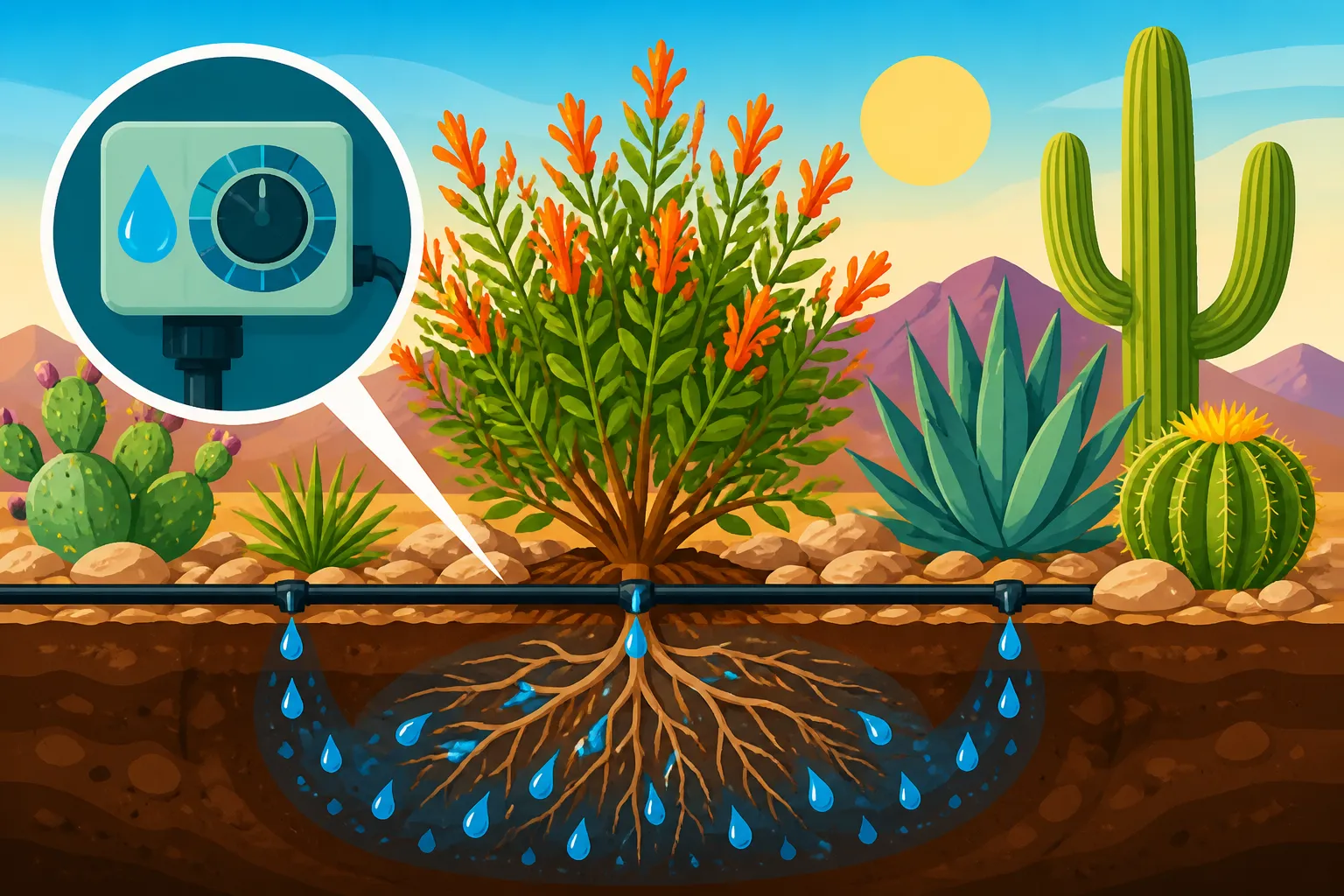
A timer tells you how long the system operates, not how deeply water moves into the soil. The same run time can produce different results in different beds. An emitter’s output, its position, the soil’s texture, and the plant’s root spread all affect how much of the root zone gets wet.
University of Arizona Cooperative Extension states that most vegetables are shallow-rooted and use water from the upper 12 to 24 inches of soil. That makes moisture in the active root zone more useful to assess than the time shown on a timer. If water is reaching only the surface, roots may have little reason to grow into deeper soil. If it moves past the roots, some of the water may be less accessible to the crop.
A useful way to think about run time is as a setting to test, not a universal recommendation. The goal is to wet enough of the soil around the roots while avoiding unnecessary runoff, puddling, or water moving below the area roots can use. You can get closer to that balance by checking soil before and after a run, then making modest adjustments based on what you find.
This approach differs from setting a timer once and assuming the same schedule will work indefinitely. Plants grow, beds change, and weather shifts. A system that suited newly planted seedlings may not wet a mature crop’s wider root area. Rain, heat, and seasonal changes can also affect how quickly soil dries. Use Watering Vegetables in Arizona: Irrigation Timing and Methods alongside your observations if you need a broader way to think about vegetable irrigation.
Start with the crop and the bed
First, consider what is growing and where its roots are likely to be. A row of closely spaced plants may share a moist area, while widely spaced crops may need water reaching farther around individual plants. A bed with different crops can also have different needs in different spots. Treating every bed as identical can leave some plants too dry while others receive more water than they need.
Next, look at the arrangement of the drip line. An emitter beside a plant stem may wet a small patch, while a line serving a row may distribute moisture along a longer strip. Neither arrangement guarantees that the entire root zone is wet. The important question is whether water spreads through the soil where roots are active, not whether the tubing is close to the plants.
For help matching emitter placement and output to crop roots, see Matching Drip Emitter Rates to Vegetable Root Depth. It can help you evaluate the hardware before you try to solve every watering problem by lengthening the run.
Understand what the timer and emitter tell you
A timer controls duration. It does not, by itself, show how much water reaches a particular plant or how far that water travels into the soil. A clogged emitter, a leak, uneven pressure, or a line that does not reach the whole bed can make the timer’s setting a poor guide to what the plants receive.
University of Arizona Cooperative Extension notes that drip emitters commonly deliver water at rates of 0.5, 1, 2, or 4 gallons per hour (gph). Check the emitter information for your system rather than assuming every outlet has the same output. If an emitter’s rate is unknown, treat the timer setting as especially uncertain until you inspect the system and see how the soil responds.
A system can also have inconsistent delivery along a line. If one plant wilts while a nearby plant looks healthy, do not immediately increase the run time for the whole bed. Check whether water is flowing from the relevant emitters, whether the line has shifted, and whether the soil is actually dry around the affected plant. A local problem may call for a local fix rather than a longer irrigation cycle.
How to check whether water reaches the root zone
The most useful check is the soil itself. Looking at the surface alone can mislead: a damp patch at the top does not prove that water has moved down to the roots, and a dry-looking surface does not necessarily mean the soil below is dry. Inspect the soil near the crop and near the emitter after the system has run.
A trowel or similar hand tool can help you examine the soil carefully. Dig beside, rather than directly through, the plant’s main stem or root area. Check at more than one depth and in more than one place along the line. You are looking for how far moisture extends and whether it spreads across the bed, not for a single perfectly uniform wet shape. The shape will vary with soil and system layout.
Take care not to mistake a narrow wet column under an emitter for a fully watered root zone. If the soil is moist only in a small spot, roots farther from that spot may remain dry. If moisture extends well below the active root area, the run may be longer than necessary for that particular bed. These are clues to adjust and recheck, not proof that every crop should receive the same treatment.
The process in Probing Soil Moisture Depth Under Vegetable Drip Lines can help you make this inspection more systematic. Repeat the check after you change the run time or modify the line; the point is to judge what the adjustment actually did.
Read what the soil is telling you
Soil texture affects how moisture spreads. In some soils, water moves downward more readily; in others, it may spread sideways or remain near the surface for a while. Compacted areas and uneven bed surfaces can also change movement. This is why advice based only on timer minutes is hard to transfer from one garden to another.
Use several indicators together:
- Moist soil near the surface but dry soil below: water may not have penetrated deeply enough, or the emitter may be delivering water too slowly or inconsistently.
- A small wet spot surrounded by dry soil: the emitter may be too far from the plant, or the water may not be spreading across the root area.
- A wet strip beneath the line but dry soil between rows: the line may be serving only part of the bed.
- Water pooling or flowing across the surface: the soil may not be absorbing water as quickly as it is being delivered, or the run may be too long without a pause.
- Moist soil extending well beyond the roots: more water may be going past the area the crop can use.
These observations do not diagnose every cause. For example, wilting can result from heat stress, root damage, or other plant problems even when soil moisture is present. Before changing irrigation, compare the condition of the soil with the condition of the plant. If the soil is moist, increasing run time may not address the real issue.
Check more than one location
Inspecting only the first plant on a line can hide uneven watering. Check plants in different parts of the bed, including areas farthest from the water supply and spots where the tubing bends or branches. If the wetting pattern changes along the line, look for blocked emitters, loose connections, leaks, or other flow problems.
Also inspect the space between plants when crops are arranged in a row. If the soil is moist only directly below each outlet, the root zone may not be connected into a continuous moist area. The crop may still be doing well, but the distribution is worth understanding before you respond to a dry patch by extending the entire system’s run.
Adjust run time and troubleshoot the system
Once you have checked the wetting pattern, adjust the system in a controlled way. Change one thing at a time where possible: run duration, emitter position, or the line serving a particular area. If several changes are made together, it becomes harder to tell which one improved the result. Then run the system and check the soil again.
If the water is not reaching deep enough, a longer run may help, but it is not the only possible solution. A clogged emitter or a line placed too far from the crop can limit wetting regardless of the timer setting. If water is pooling, running continuously for longer may make the problem worse. Consider whether the system needs attention or whether water delivered in separate cycles would allow the soil time to absorb it. Observe the result rather than assuming that one adjustment fits every bed.
A basic adjustment routine looks like this:
- Check the soil before irrigation to see whether it is already moist in the root area.
- Run the system using its current setting.
- Inspect the soil near emitters, between emitters, and in different parts of the bed.
- Note whether moisture has reached the area roots use, and whether there are dry or overly wet patches.
- Change the run time or address a system problem, then check again after the next run.
This is a process for learning how your garden behaves, not a fixed schedule. Keep a simple note of the bed, crop, system setting, and soil observations. That record can help you recognize patterns as plants grow or conditions change. If you manage several beds, do not assume that one bed’s successful setting will work everywhere.
Check the hardware before extending a run
A drip system that does not distribute water evenly can tempt you to increase the timer setting for all plants. Before doing that, inspect the system. Look for visible leaks, disconnected tubing, emitters that appear blocked, or outlets that are not positioned beside the plants they serve. A problem that affects one section may be better solved at that section than by watering every bed longer.
A useful check is to observe the system while it is operating. Confirm that the outlets are delivering water and that the tubing is not kinked or pulled away from the crop row. Compare the soil near an outlet with soil farther down the line. If the results differ, investigate the distribution rather than relying on the timer alone.
Different emitters can also make a single timer setting unsuitable for every part of a garden. If a system combines outlets with different delivery rates, the same run duration will not mean the same amount of water at each outlet. Where practical, group areas with similar needs and delivery hardware, or adjust the layout so the system can serve them appropriately. The goal is to avoid using one long run to compensate for an inconsistent setup.
Consider the crop’s stage and changing conditions
A seedling and a mature plant do not occupy the same amount of soil. As roots spread, the useful wetting area may need to spread too. An emitter that was well placed close to a young plant may become poorly positioned later. Inspect the bed as the crop grows, especially if plants are uneven or the soil dries differently around them.
Weather and season matter as well. Warm, dry conditions can make a bed lose moisture faster, while rainfall may reduce the need for irrigation. Instead of changing settings according to a calendar alone, check the soil and take recent conditions into account. How Often to Soak Established Vegetables During Warm Weather offers related guidance for thinking about established crops as conditions shift.
Watering time of day can be part of good irrigation practice, but it does not replace checking depth and coverage. For more on that aspect, see Why Morning Irrigation Helps Prevent Vegetable Foliar Disease. Whichever time you choose, the same question remains: does the system wet the root area evenly without wasting water beyond it?
Build a repeatable routine for Arizona vegetable beds
A dependable drip routine comes from observation, maintenance, and occasional adjustment. It does not require a perfect moisture pattern at every point in the bed. It does require knowing whether the crop’s root area is getting water and whether the system is delivering it as intended.
Start by dividing the garden into areas that make sense to manage together. Beds with similar crops, emitter arrangements, and soil behavior may be easier to evaluate as a group. Keep areas with clearly different layouts or watering responses separate when possible. A single timer can still control a system, but you should not assume that every bed connected to it has identical needs.
Make a habit of checking soil moisture before changing the timer. If soil is still moist around the roots, the plants may not need another run yet. If the soil is dry at the root depth, inspect the system and consider whether run duration or coverage needs adjustment. If the soil is wet below the root area, shortening the run may be appropriate. Let the soil evidence guide the change.
Keep simple notes
A brief record can prevent repeated guesswork. Note which bed you checked, where the emitter sits, whether the soil was dry or moist at different depths, and what you changed. You do not need an elaborate tracking system. The value is in comparing what happened after a change with what you observed before it.
Use notes to identify repeating patterns. Perhaps one part of a bed stays dry despite a long run, or a certain emitter repeatedly leaves a narrow wet patch. Those patterns suggest a placement or hardware issue rather than a need to keep increasing the timer. If the garden changes, update the record; a growing crop or a rearranged line can alter the results.
Avoid the common shortcuts
Several shortcuts sound convenient but can lead to poor decisions:
- Using plant appearance alone: Wilting does not always mean the soil is dry. Check moisture before adding water.
- Trusting a damp surface: Moisture at the top does not show how deeply water has moved.
- Assuming every emitter is identical: Verify the outlet type and inspect delivery across the line.
- Extending the whole system to solve one dry spot: First check that spot’s emitter, tubing, and placement.
- Leaving a setting unchanged as plants grow: Recheck the wetting pattern as the crop’s root area changes.
- Assuming rainfall solved the problem: Check the bed itself, since rain may not reach every sheltered or densely planted area evenly.
For readers comparing irrigation approaches, Watering Vegetables in Arizona: Irrigation Timing and Methods provides related context. If you are watering vegetables in containers rather than in-ground beds, their limited soil volume and layout call for a different set of checks; see Summer Watering Schedules for Arizona Container Vegetables.
The most useful run time is the one that suits your system and your bed, as confirmed by soil moisture. Set the timer, inspect the wetting pattern, and adjust when the evidence points to a change. That routine is more reliable than copying a duration from a different garden.
Frequently Asked Questions
Should every vegetable bed use the same run time?
Not necessarily. Beds can differ in crop, soil, emitter output, and layout. Check each bed’s soil and distribution before deciding whether settings should match.
What should I do if a plant wilts but the soil is moist?
Check the soil near the plant and inspect the system before adding water. Moist soil means that simply extending the run may not solve the cause of wilting.
Is a longer run always better for deeper watering?
No. A longer run may help when the root area is too dry, but it can also lead to pooling or water moving beyond the roots. Inspect the soil after irrigation and adjust based on the result.
How often should I check the wetting pattern?
Check after an adjustment and whenever the crop, system, or conditions change enough to affect how water reaches the bed. Regular observation helps catch uneven delivery before it becomes a persistent problem.
Sources
- University of Arizona Cooperative Extension — Ten Steps to a Successful Vegetable Garden | UA Cooperative Extension (checked November 15, 2026)
- University of Arizona Cooperative Extension — The Basics of Drip Irrigation for Landscaping | UA Cooperative Extension (checked November 15, 2026)
Disclaimer
This article is for general informational purposes only and does not constitute professional advice. Laws, prices and regulations vary by location and change over time. Consult a qualified professional for guidance on your specific situation. Arizona Gardening Guide is not a government agency and is not affiliated with any university extension, state department of agriculture or other government agency.